Sunday, February 12, 2012

Jewel of the Nile: Edfu and Kom Ombo

We arrived in Edfu early in the morning and took a horse-drawn carriage to the temple.


This temple is dedicated to Horus, the falcon god.  Before he was born, his mom Isis and his dad Osiris were madly in love.  Osiris's brother Seth was evil and plotted to kill Osiris to have Isis for himself.  He cut Osiris into 42 pieces and scattered him all over the world.  Isis searched for 500 years and only found 41 pieces of her husband; she was missing the critical "man part."  Ra, the sun goddess, turned Isis into a sparrow so she could fly up the Nile continuing her search for the missing piece.  After another 500 years when she still hadn't located it, Ra brought Osiris back to life.  Together, Isis and Osiris conceived Horus.


Horus
This temple is only about half as old as the other temples we saw, so the carvings were very vivid.  Keep in mind, half as old is still more than 2,300 years old!


Back of Edfu Temple


We got back on the boat for a lunch break while we sailed to Kom Ombo--the crocodile goddess's temple.

"Lunch Break"

The most amazing thing about Kom Ombo was seeing the carving describing a caesarean section.  


Oh yeah, did I mention our tour guide Sal is fluent in hieroglyphics?  Because he is.  Awesome.


Dan and Jon got up-close and personal with some baby cobras before we took a shisha break.


Dan also briefly became part of the band.


We made it an early night since we had to be up at 3 a.m. (!!) the next day.

Sunset over the Nile

Read about our other stops along the Nile:
Abu Simbal
Luxor I
Luxor II
Giza
Cairo

Thursday, February 9, 2012

Kitchen Table Update

I'll take a break from Egypt pictures for a minute to update you on the kitchen table situation.  When we last spoke, I had sanded and spray painted my free kitchen table.  It was looking a little splotchy, so I attempted to re-sand and re-paint it.  I can't say that it's perfect, but as my friend Karen says, you want things to be wonky so that people know it's homemade :)


See the shiny spots on the top corners?  I can't seem to get those out no matter how hard I try.


I thought that it might look better in situ, so I moved the table from the conservatory into the kitchen.  You know what?  The shiny spots are not nearly as noticeable.


Or maybe they are, but once you accessorize you can hardly tell.


Tuesday, February 7, 2012

Jewel of the Nile: Luxor II

The next morning we went to the Karnak Temple, which our tour guide Sal believes should be one of the ancient wonders of the world. I totally agree. It is 134 acres and required three separate foundations to keep it stable: basalt, granite and limestone. These foundations allowed the temple and its obelisks to remain upright after 4,300 years even through major earthquakes and other natural disasters.

Karnak Temple

Remember when I mentioned that new leaders of Egypt would have to fight a bull at their coronation ceremony?  Well, after they won, they would travel down the Nile to Luxor and come to this temple.  To further prove their worth, they would have to swim 42 laps around the pool and run 42 laps around the temple.


I loved walking around this temple.  I love all of the pillars, carvings and statues. 


Archeologists believe that one of the rooms was used to tell time.  Apparently light hits each pillar only at a certain time of day.  You can tell what time it is by counting how many of the pillars are lit.


We had some free time in the afternoon, so we made some gin and tonics, played some cards and sunbathed as the Nile floated by. Can you think of a more perfect afternoon?


View from the Nile
We passed several villages while floating down the river.  I noticed two main things: people seem very poor, and people seem very friendly.  Everyone--man, woman and child--waved to us as we passed.


That evening we had to go through a lock to get to Edfu.  This was a prime opportunity for villagers in boats to come sell their wares.  I've never seen anything like this before.  I'm glad Sal warned us in advance!  What happens is men in small boats row up to our ship and start calling to people on the top deck.  (They seem to be fluent in several languages.  I heard Spanish, Italian and English.) When they have your attention they throw you a plastic bag with something in in--usually a scarf or tablecloth or traditional Egyptian dress called a galabia.  You probably didn't indicate that you were interested in the item, but they threw it anyway.  Now it's up to you to either throw it back or buy it by putting money in the bag and throwing that back down.


I actually participated in this activity. Earlier in the trip I asked my friend Jon if he'd wear a galabia if I bought it for him.  I'm pretty sure he thought they'd be a lot more expensive than they were, so he said yes.  I found the tackiest, most sparkle-adorned women's galabia I could find and bargained with one of these sellers for it.  It was a lot of pressure to make the sale quickly because our boat was almost through the lock and we had no time to spare.  I finally got the seller to agree to a fair price of 35 EGP ($6), but I only had 40 and no change.  Long story short, we ran out of time so he threw me the galabia; I threw him the 40 EGP and we called it a day.  It was hilarious and totally worth it.  Don't you think?

Looking good in a Galabia

Read about our other stops along the Nile:
Abu Simbal
Edfu and Kom Ombo
Luxor I
Giza
Cairo

Monday, February 6, 2012

Jewel of the Nile: Luxor

After our shisha and mint tea, we made our way to the train station to catch our sleeper train to Luxor.  Trains in Egypt run on a loose schedule.  The trains can leave anywhere between two hours before and an hour after the scheduled time, so you have to show up to the station early just in case.


We got to Luxor around 7 a.m. and went straight to the Valley of the Kings.  The valley has more than 60 tombs; the entrance fee allows you to go in three of them.  The open tombs are regularly rotated to avoid too much damage to the artwork.  We weren't allowed to take any pictures, but trust me when I say it was absolutely fantastic!  We saw the tombs of Seti II, Sapetah, and Ramses III.

We were very lucky that the Ramses tomb was open.  Sal, our tour guide, says that tomb is one of the best.  I can definitely see why.  There were huge, intricate murals with very bright colors on all the walls and ceilings.  I really loved all the false tombs (rooms that did not lead to the actual mummy) and the niches carved in the walls.

image from here

We also paid a separate fee ($10) to see King Tutankhamen's tomb. The tomb itself is really small--especially compared with Ramses III--but when it was found in 1922 it was packed to the gills with treasures.  We saw a lot of those treasures in the Egyptian museum in Cairo, but here we got to see actual King Tut!!  His mummy is at the back of the tomb near his golden sarcophagus.  It was really crazy to see.

After exploring the Valley of the Kings, we made our way to Hatshepsut's temple.  This Pharaoh is widely considered one of the best ancient Egyptian leaders, though she was quite a controversial character.  Apparently, she fled the palace in the north after she got pregnant by her tutor who was 47 years her senior!  She established her own kingdom in the south and eventually ruled all of Egypt.

Temple carved out of a mountain


Pregnant Hatshepsut

It's hard to believe that the colors on these walls are 4,000 years old!

There are still lots of on-going digs in Egypt.  We drove by one that Sal actually has been a part of.


We also visited an alabaster factory and learned how they make the vases by hand.

Making an alabaster vase

Finally, we got to see our boat and take a shower!  The boat was incredible.  Our room was enormous (for a boat) and really comfortable.

Check out those windows!

That evening we saw the Luxor Temple.  It was incredible!  I am so happy we went at night because it really added to the whole experience.


The temple is huge and consists of three rooms: the outer room is for non-believers; the middle room is for worshipers; and the inner room is the holy-of-holies for the priests.  Outside the temple is a row of sphinxes.  So far, they've uncovered quite a few of them, but archeologists think that the row actually extends all the way to the Karnak Temple which is 3 km away!

Row of Sphinxes

More than 800 years ago a mosque was built inside the temple to honor the mayor of Luxor.  The mosque is still operational; hearing the evening call to prayer while looking at ancient Egyptian hieroglyphics was an interesting juxtaposition.

Mosque inside Luxor Temple

One really interesting part of the temple was the wall honoring Alexander the Great and depicting him as a Pharaoh.  Apparently, the Egyptians loved Alexander the Great and treated him as one of their own.  He is the only Greek who was afforded the title Pharaoh; everyone after him was a Ptolemy.

After the Luxor Temple we made our way back to the boat for some dinner and evening entertainment: belly dancing and whirling dervish!  The belly dancer was...interesting.  She was a little older and a little chubbier than I was expecting, but she did have some moves.  She showed them off best when dancing with a baby (?!) and with Dan.

I'd never heard of whirling dervish before, but it is fascinating.  It is a dance in which the performer spins the entire time.  He never stops moving, even while balancing things on his head or blindfolding himself.  He had two very colorful skirts that he used as props in his dance.
As you can see, it was a very long, but very exciting day.  Next up is the Karnak Temple!


Read about our other stops along the Nile:
Abu Simbal
Edfu and Kom Ombo
Luxor II
Giza
Cairo

Thursday, February 2, 2012

Jewel of the Nile: Giza

You can't go to Egypt without seeing the pyramids, so that's what we did on day 2.  Our first stop was the step pyramid complex.  This was the first pyramid built in Egypt and it is more than 4,000 years old.


The temple that surrounds the pyramid is where coronations for pharaohs and kings and queens were held.  Side note--I learned the difference between pharaohs and kings/queens is that pharaohs were considered immortal gods where kings and queens were human.


As part of the coronation ceremony, the new leader would fight a bull in the center of the court.  The bulls won often enough to necessitate the next-of-kin sit in the bleachers.  When the bull lost though, the new leader would cut off his tail and wear it as a symbol of power.  I never knew this before, but when you see hieroglyphics of pharaohs, they usually have a bull tail.


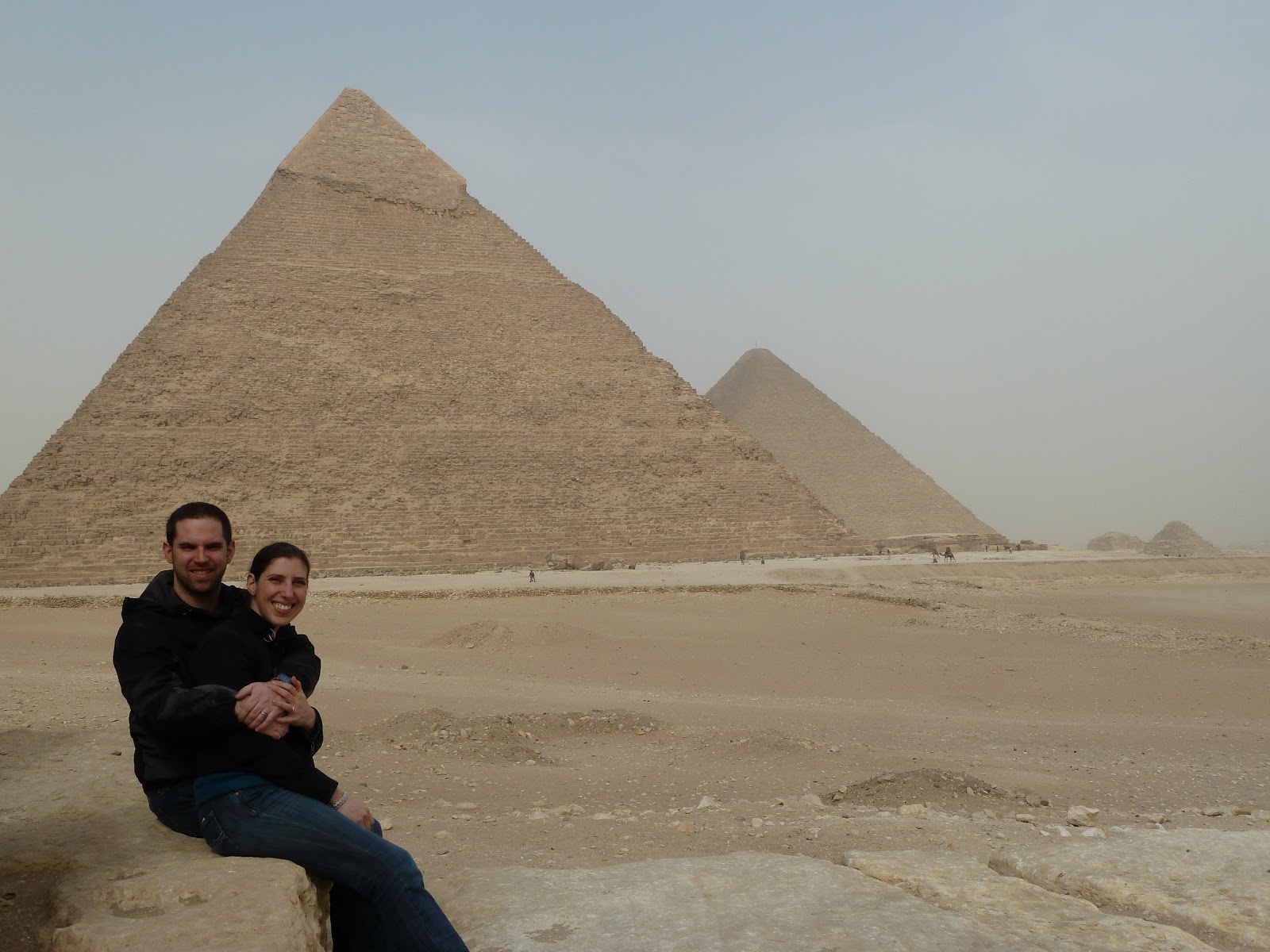
Next up were the pyramids of Giza.  Did you know that these used to be covered in granite and painted?  I can't even imagine what they would have looked like back then.  Also, granite is always 5 °C colder than the air, and limestone is always 2 °C colder than the air.  This means that the burial chamber, which is in the center of the layers of limestone and granite, was as cold as a refrigerator!  The ancient Egyptians not only mummified their dead, they also kept them cold!

Walking like an Egyptian


There are more than 97 man-made pyramids in Egypt, and in ancient times, each pyramid had its own sphinx!  It also had three smaller pyramids for the owner's wife and two of his daughters.  


One of the benefits of going to Egypt now was that we mostly had the country to ourselves, though there were occasionally some other tourists.

Move already!

Me and Sarah at the Sphinx


Cute couple, no?

After a full day of touring, we had a fantastic meal at a local place called Gad.  We had falafel and a local specialty called foul (pronounced fool).  It was amazing and only cost $1.50 for two of us!!

We had just enough time for some shisha and mint tea before we caught our sleeper train to Luxor.


It's just tobacco...I promise!

Read about our other stops along the Nile:
Abu Simbal
Edfu and Kom Ombo
Luxor I
Luxor II
Cairo